
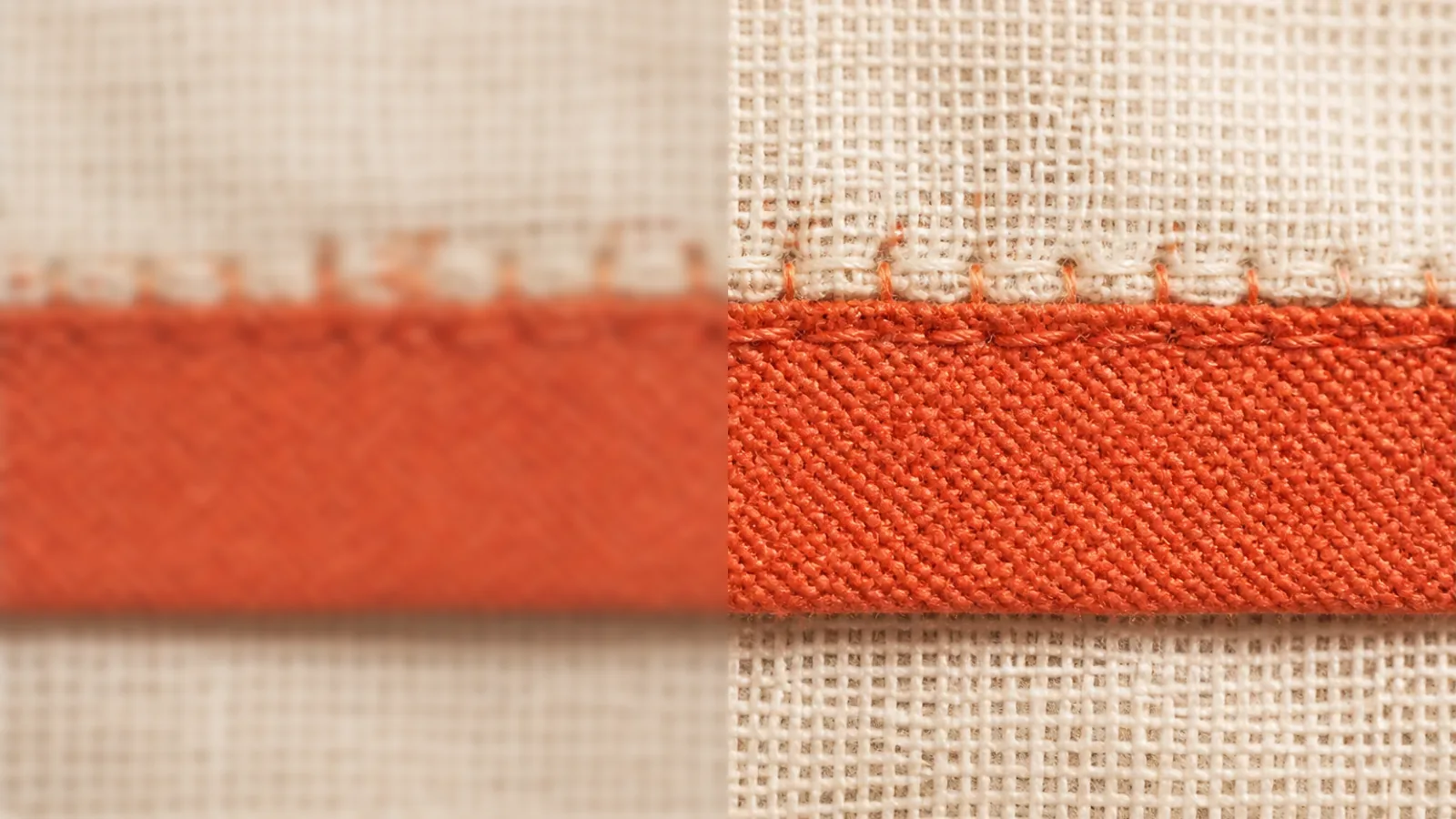
The 95 % range at this age runs from 3.22 to 13.64 cycles per degree. Individual babies vary enormously, and a figure quoted without that band is a figure quoted misleadingly.
Colour
On the red–green axis the model puts chromatic discrimination at about 100 % of its mature value at this age, and on the blue–yellow axis about 100 %. Both channels are working within the first couple of months — the common claim that babies cannot see blue for months has weaker support than it sounds.
Why other sources give a bigger number
Measured by recording the brain’s response to a grating rather than by watching what a baby looks at, the same age gives about 19.4 cycles per degree instead of 6.63 — a factor of 2.9. Neither is wrong: the brain’s response estimates the detail the eye and early brain pass along, while watching what a baby looks at estimates what the baby demonstrably responds to. This site reports what babies look at, because that is the question a parent is asking.
Hearing
At this age a sound has to be about 9 dB louder than it does for you before a baby responds to it at all. The gap closes from the top down: high frequencies are close to adult within the first year, and low frequencies take until school age.
What the numbers mean
Around 20/90. Roughly four and a half times coarser than adult vision, which is close enough that the remaining gap is mostly about the very finest detail.
Did you know?
A phone screen cannot reproduce the light levels real vision works across. Whatever this app shows you is a perceptual approximation with that limit stated — and the limit is not a caveat added afterwards, it is part of the answer.
The longer answer
Improvement is slowing. The steep part of the curve is behind, and what remains is a long approach that continues for years after the first birthday.
What catches their eye now
Ranked by what this age is actually good at: bold, close and moving. Nothing here is a milestone and nothing here is a test.
Books with finer detail
Detail this fine is only now within reach — at birth it would have been a grey smudge.
Find one · AmazonA picture book
Pictures with clear shapes and real colour are now inside what can be resolved at reading distance.
Find one · AmazonBlocks of strong colour
Both colour channels are working by now, so a difference that is only colour — not light and dark — starts to be worth something.
Find one · AmazonAs an Amazon Associate I earn from qualifying purchases. The ranking above is not for sale.
Sources
- Banks, M.S. & Salapatek, P. (1978). "Acuity and contrast sensitivity in 1-, 2-, and 3-month-old human infants." Investigative Ophthalmology & Visual Science 17(4), 361–365.
Acuity estimated a different way, from where full contrast sensitivity functions cut off, and the very low spatial frequency of peak contrast sensitivity in early infancy. - Banks, M.S. (1980). "The development of visual accommodation during early infancy." Child Development 51(3), 646–666.
That steady-state focus error and accommodative response slope improve up to about 3–4 months, and that accommodative error does not meaningfully limit infant acuity. - Braddick, O., Atkinson, J., French, J. & Howland, H.C. (1979). "A photorefractive study of infant accommodation." Vision Research 19(12), 1319–1330.
Consistent focusing behaviour at a low accommodative demand of about 1.3 D (≈ 75 cm) emerging between 3 and 6 months. - Clavadetscher, J.E., Brown, A.M., Ankrum, C. & Teller, D.Y. (1988). "Spectral sensitivity and chromatic discriminations in 3- and 7-week-old human infants." Journal of the Optical Society of America A 5(12), 2093–2105.
That few 3-week-olds show reliable chromatic discrimination while most 7-week-olds do, and the long-wavelength advantage at 3 weeks. - Haynes, H., White, B.L. & Held, R. (1965). "Visual accommodation in human infants." Science 148(3669), 528–530.
The median 19 cm focus distance in alert newborns — the origin of the "babies see 8–12 inches" claim, cited so the app can state what the paper does and does not support. - Held, R., Birch, E.E. & Gwiazda, J. (1980). "Stereoacuity of human infants." Proceedings of the National Academy of Sciences 77(9), 5572–5574.
The abrupt onset of stereopsis between about 3 and 5 months — explained in the app and never drawn, because a flat screen cannot present it. - Mohn, G. & van Hof-van Duin, J. (1986). "Development of the binocular and monocular visual fields of human infants during the first year of life." Clinical Vision Sciences 1(1), 51–64.
The restricted newborn visual field and its expansion over the first year — described in the app, deliberately not rendered as a vignette. - Neijzen, C.M., de Wit, F.M., et al. (2025). "Reference values for the Teller Acuity Cards II (TAC II) in infants and preverbal children, a meta-analysis." Acta Ophthalmologica. doi:10.1111/aos.17447.
The behavioural binocular grating-acuity curve the app renders, and its stated uncertainty of approximately 0.16 log10 units, flat with age. - Norcia, A.M. & Tyler, C.W. (1985). "Spatial frequency sweep VEP: visual acuity during the first year of life." Vision Research 25(10), 1399–1408.
The swept-VEP acuity curve reported alongside the behavioural one as an upper bound, and the 24.3 c/deg adult reference measured in the same apparatus. - Norcia, A.M., Tyler, C.W. & Hamer, R.D. (1990). "Development of contrast sensitivity in the human infant." Vision Research 30(10), 1475–1486.
Contrast threshold at low spatial frequency falling from 7 % at 2–3 weeks to a 0.5 % asymptote by 9 weeks, against an adult 0.32–0.22 %, and the two-phase shape of contrast development. - Peeples, D.R. & Teller, D.Y. (1975). "Color vision and brightness discrimination in two-month-old human infants." Science 189(4208), 1102–1103.
Established red/white chromatic discrimination at two months of age. - Regal, D.M. (1981). "Development of critical flicker frequency in human infants." Vision Research 21(4), 549–555.
Low critical flicker fusion frequency in the first weeks reaching near-adult values within months — described, not rendered. - Skelton, A.E., Maule, J. & Franklin, A. (2022). "Infant colour perception: Insight into perceptual development." Child Development Perspectives 16(2), 90–95.
The review timeline placing the emergence of colour vision between about 3 weeks and 3 months. - Varner, D., Cook, J.E., Schneck, M.E., McDonald, M. & Teller, D.Y. (1985). "Tritan discriminations by 1- and 2-month-old human infants." Vision Research 25(6), 821–831.
Demonstrable tritan (S-cone) discrimination at 1 and 2 months, which is why the app does not dramatise a months-long absence of blue-yellow vision. - ISO 226:2003, Acoustics — Normal equal-loudness-level contours; with Fastl, H. & Zwicker, E. (2007). Psychoacoustics: Facts and Models, 3rd ed. Springer (minimum audible field).
The adult minimum-audible-field reference curve that the infant elevation is added to. - Olsho, L.W., Koch, E.G., Carter, E.A., Halpin, C.F. & Spetner, N.B. (1988). "Pure-tone sensitivity of human infants." Journal of the Acoustical Society of America 84(4), 1316–1324.
The primary pure-tone threshold dataset underlying the infant audiogram. - Werner, L.A. (2002). "Infant auditory capabilities." Current Opinion in Otolaryngology & Head and Neck Surgery 10(5), 398–402.
Behavioural thresholds of 40–55 dB SPL at 1 month falling to 10–30 dB SPL by 6–12 months; a 4 kHz threshold only ~10 dB above adult at 6 months while low frequencies mature into childhood; and that cochlear function is mature at term, so the elevation is middle-ear and central.
This is not a vision or hearing test. If anything worries you, speak to your paediatrician or a paediatric eye doctor.
This is a perceptual approximation, not a reconstruction of what your baby sees. Real babies vary a great deal from one another.